
EuCAPT brochure
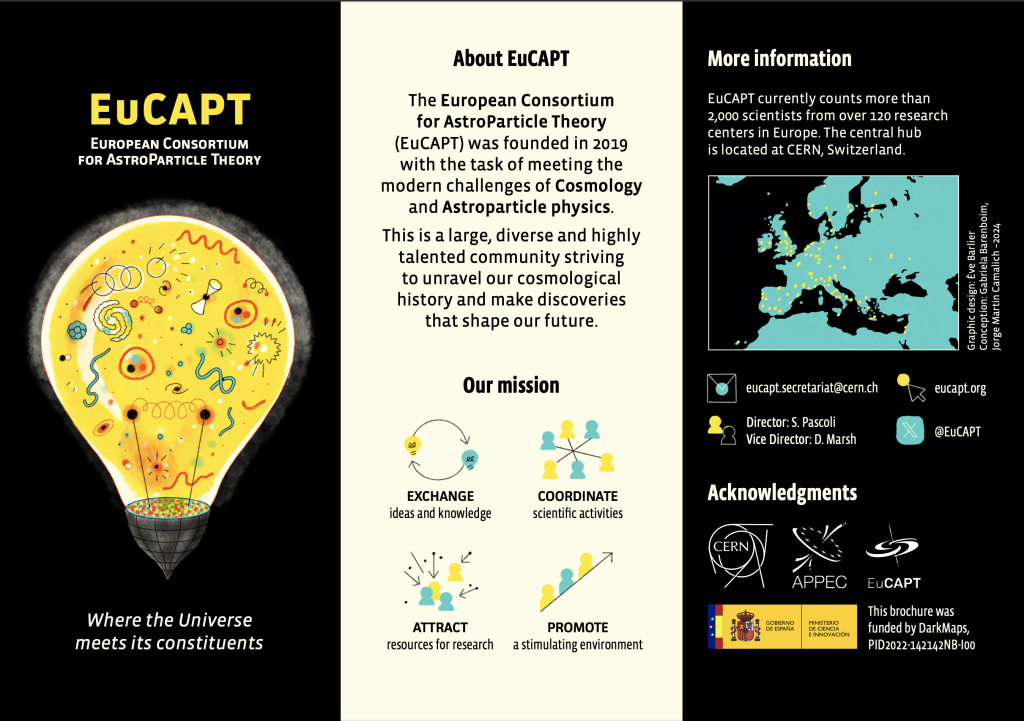
A EuCAPT brochure can be downloaded here for use by researchers wanting to communicate the work of EuCAPT to non specialists and funders.
EuCAPT White Paper
This White Paper (WP) was initiated by the Steering Committee of EuCAPT, with the aim to identify the opportunities in our field for the next decade and to strengthen the coordination of Astroparticle Theory in Europe. It is addressed to the whole astroparticle community, and rather than attempting to review the current status of the whole field of research, it focuses on the upcoming theoretical opportunities and challenges, with particular emphasis on the possible synergies among different subfields.
The material is organised around 10 themes of research, each of which was coordinated by several scientists as listed below.
- Astrostatistics: Christoph Weniger, Roberto Trotta
- Dark Matter: Francesca Calore, David J. E. Marsh, Chris Byrnes
- Dark Energy: Alessandra Silvestri, Julien Lesgourgues
- Cosmic accelerators: Sera Markoff, James Matthews, Enrico Ramirez Ruiz
- Dynamical spacetimes: Rafael Porto, Philipp Moesta
- Early universe: Daniel Baumann, Laura Covi
- Nuclear Astrophysics: Tetyana Galatyuk, Tanja Hinderer
- Neutrino Properties: Thomas Schwetz, Olga Mena
- Particles from stars: Aldo Serenelli, Irene Tamborra
- Travelling Messengers: Daniele Gaggero, Kumiko Kotera
The definition of these research themes is somewhat arbitrary, as there are many connections and no clear boundaries. The structure offers a perspective which we believe is more natural for practicing theoretical astroparticle physicists and cosmologists, and complementary to that offered by e.g. the European Astroparticle Physics Strategy document, which is instead organised around different messengers.
The final document includes contributions from 135 scientists, who participated in the brainstorming sessions at the first EuCAPT annual Symposium held at CERN from May 5 to 7, 2021, and provided feedback via a dedicated channel on the CERN Mattermost community platform. The paper has been endorsed by several hundreds of members of the community.